Baby Boomers vs. The Internet

Fact #1:

According to the U.S. Census Bureau, Census 2000, the majority of homeowners are between the ages of 35 and 55.

Fact #2:

eNeighbors sells an online communication service that serves as private social network and communication tool for managed communities and neighborhoods.

Conclusion:

This would lead one to believe that the primary audience for the eNeighbors web service is the baby boomers since they make up the majority of the residents living in most neighborhoods.

Now we all know that this particular generation has a varied mix of tech savviness. For example, my parents couldn’t tell you what a social network is let alone why they would want one. On the other hand, most of the top tech companies where founded and are now operated by this same generation.

So, how do you market to this audience? Great question.

The answer is: We don’t know.

Seth Godin touches on this dilemma on his blog today. His summation is essentially that psychographics are more important than demographics when it comes to this audience. I would agree. Just because they are older doesn’t mean they don’t get it. eNeighbors is banking on this fact.

So far, all I can tell you is that people love being social (even the old ones). As broadband penetration keeps growing and the older generation gets more comfortable with technology, they’ll want to stay in touch. Especially within their local offline community.

That’s when eNeighbors will be there for them.
Geocaching: 21st Century Treasure Hunt

When I was a kid, my brother and I would ride our bikes down to the EZ Shop and buy candy for our “treasure hunts” that we would journey upon in the back yard. We would then painstakingly create riddles, clues and pace counts (12 paces to the “forked tree”) in order to complete our treasure map.

These days, geocaching is all the rage. Using sites like Geocaching.com and Google Earth, modern day treasure hunters can explore unknown territories via handheld GPS devices or a laptop. Treasure caches are all over the place in even the most unlikely places. I found at least a dozen of them within 5 minutes of my house in suburban Kansas City.

There are currently a few online communities actively supporting the geocaching community, but wouldn’t it be great if there were was a way to create a local group right within your own neighborhood. Imagine having a geacaching treasure hunt at your next community barbeque or outdoor social gathering.

This is exactly the sort of thing that the eNeighbors “Groups” feature offers. Groups allows you to create your very own mini social network within your neighborhood eNeighbors site. Members can stay up-to-date on the latest events for that particular group by checking the Group page and engaging in an online conversation with other members. The Group leader can manage the member list, and the leader also has the ability to send out emails to the entire Group at once.

Read more about Groups here.

Conversation Architects

David Armano, Creative VP at Digitas, just published a great article on Business Week. He starts out by making the point that we are all consumers in all aspects of our life, so how do you market to all of us these days…?

His proposal — become a conversation architect (great concept, btw). We need to facilitate the exchange of information, create affinity around brands and communities, and ultimately let the medium drive the message.

I love the sound of this! Here’s a great excerpt from the article that just nails the shift in the mental state that needs to happen:

Consider the example of a typical creative brief template, which usually says something like, “What are we trying to communicate?” Can you see the old-world residue in the word “communicate”? It lacks the dimensions of experiencing something and having an ongoing two-way dialogue. “What are we trying to communicate?” implies a one-way conversation. Maybe we should ask ourselves: “How can we facilitate?”

Enter eNeighbors.

For decades, since the inception of homeowners associations, there have always been a select few (i.e. the board of directors) that communicate in a one-way manner with the remainder of the community residents. Sure, there are meetings where all are invited, but who actually shows up? And how many?

The greatness of eNeighbors lies in the ability to facilitate a conversation between not only the board members and the rest of the residents but between the residents themselves, and at the same time allowing that conversation to happen at any time day or night within the convenience of your own home.

I know… why hasn’t anyone done this before? Well, we have now. Feel free to converse amongst yourselves.

The Edge of Greatness

Over the weekend, Perry Evans of evans ink posted an interesting insight into what he calls “conversational commerce.” The basic premise is that small business owners need to leverage the growing consumer participation on the internet in the ever-expanding world of social network sites to create connections to their local services.

He mentions ServiceMagic’s efforts to create some of these connections, but indicates that otherwise there are not any real superstars in this field yet.

Here’s my favorite quote:
The chasm between potential and reality is still huge and the ‘live web’ is a truly compelling blank slate.

Now I’m not sure if this makes me nervous or extremely excited. eNeighbors is trying to do this exact thing.

First and foremost, we provide a unique communcations platform for neighborhoods, but a close second is the goal to create a local ad platform for highly focused local service providers.

So, either we are on the edge of greatness, or we are headed down an ill-fated path littered with the remains of our failed predecessors.

No pressure.

—————————————-

Read Evans’ entire post here

Local Advertising & Local Content

The “Drilling Down on Local 2007” conference sponsored by The Kelsey Group finished up in Santa Clara a couple weeks ago.

Hilary Schneider of Yahoo was one of the keynote speakers presenting Yahoo’s efforts in the local advertising space. She stresses that the demand for local search is growing each year and the potential ad revenue is in the billions.

Additionally, Peter Horan, the CEO of IAC Media & Advertising, also discussed the local opportunities. Specifically, he mentions integrating professionally produced content with user generated content in an effort to capture the user’s attention in their search for local service information.

This integration of content at the local level from a trusted source that is targeted to a hyper-local audience is the exact model that eNeighbors hopes to drive. Imagine having a prescreened roofer or plumber advertise on your local neighborhood website right where you already read the latest news about your community. The local service providers can start coming to you rather than you searching them out. And it’s all done in a subtle, approachable way that is not “in your face” with sales pitches.

What makes a successful social network?

In her new book, Momentum, Allison H. Fine makes a point that is central to what makes eNeighbors tick:

“Two key characteristics of social networks are critical to their success. First, successful networks have hubs of information and leaders who drive the work. Second, information in social networks flows in a “friction-free” way to enable and empower people to work quickly at the outer fringes of the network.”

In the case of eNeighbors, the hub is the web-based application on the internet. The leaders are the board of directors. And the empowerment to the people (or neighborhood residents in this case) is made possible by the different ways you can share information with the eNeighbors application.

Oh, and happy birthday Allison.

What is eNeighbors?

So, what is eNeighbors? Here’s the introductory content from our website: eNeighbors.com

“eNeighbors is the first online communication tool designed specifically for neighborhoods and their residents. It is private, secure, and easy to set up.”

Basically, that means that we have created a web-based application that allows neighborhoods to communicate more easily than ever before. Unlike traditional websites that HOAs or neighborhoods put up for their residents, our application allows every resident to contribute. You also don’t need a web developer to create or maintain the site and its content. The eNeighbors application is so much more than a website. It also provides great social networking features that you might be familiar with on sites like Evite, Craigslist, and Meetup.

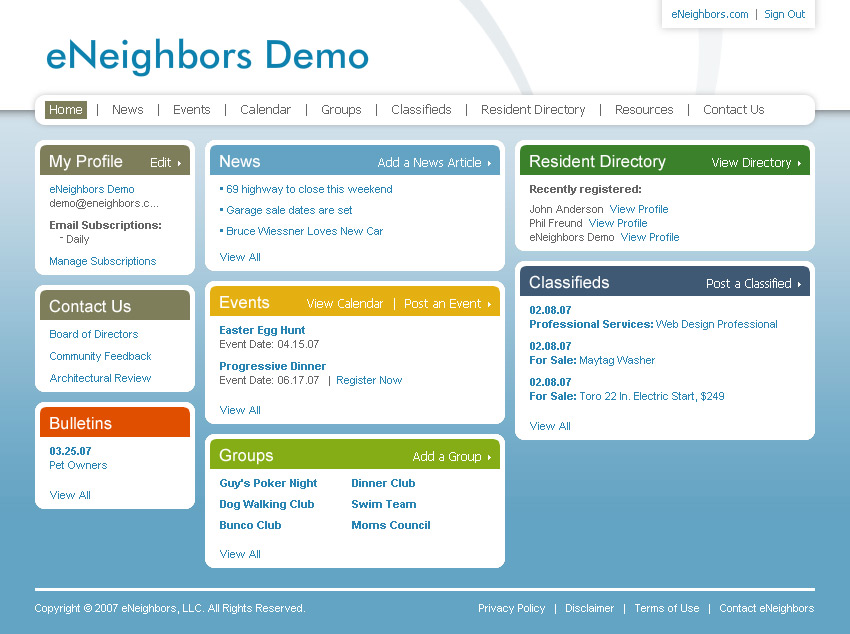
As promised, here’s a look at the application. This is the “Home” page a resident sees once they sign in to their account.

The primary services are:

1. News (post, read, and comment on the local news in your neighborhood)

2. Events (create and sign up for social events — an RSVP option is also available)

3. Groups (create a social group for you and your friends)

4. Resident Directory (address info for each registered user — phone numbers are only displayed if the resident chooses to)

5. Classifieds (you can post “wanted”, “for sale”, or “professional services” items)
eNeighbors Resident Dashboard

eNeighbors 2.0

Welcome to the eNeighbors blog. This is the inaugural post. If you are reading this, a year from now you’ll be able to say you knew us when… We have high hopes here at eNeighbors, and we’re just getting started.

We’ve just recently finished putting the finishing touches on our new web application. Check back for more info on the release. It’s technically still in beta, but will be ready for mass consumption very soon.

Cheers!

– Phil